
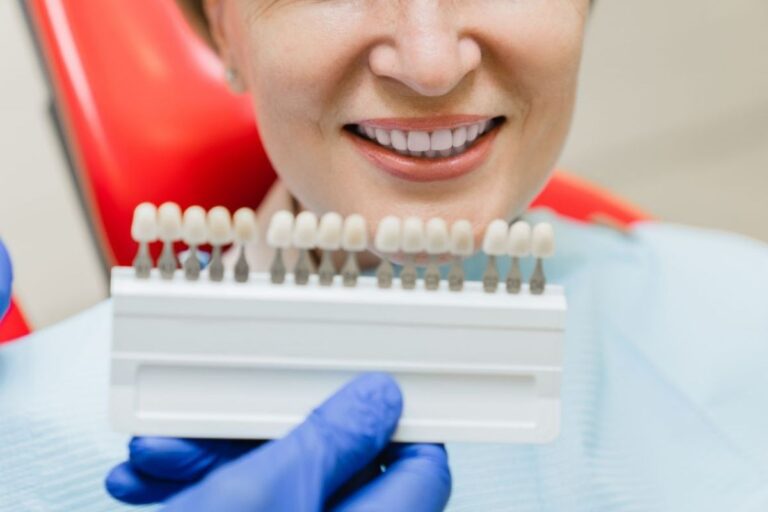
If you’ve ever noticed someone’s veneers looking unnaturally white, bulky, or mismatched, you already understand that veneer results aren’t always equal. What actually makes veneers look natural comes down to a handful of precise design decisions, starting with shade selection and extending all the way to how the porcelain interacts with light. At Metropolitan Dental Arts, our cosmetic dentist team approaches every smile makeover as a balance of science and artistry. When all the right variables align, veneers don’t just look good. They look like your actual teeth, only better.
The Real Factors Behind Natural-Looking Veneers
1. Shade Selection Goes Beyond Just “White”
One of the most common mistakes in poorly done veneers is the unnatural, bleached look they carry. Natural teeth aren’t a single solid color. They have subtle value gradations, typically lighter near the incisal edge and slightly warmer near the gumline.
A skilled cosmetic dentist evaluates your skin tone, eye color, hair color, and existing teeth before selecting a shade. The goal is a color that enhances your smile without overpowering your facial features. Porcelain that’s too bright reads as artificial, especially in photographs and natural light.
2. Translucency Is What Makes Teeth Look Alive
Real teeth are semi-translucent. Light passes through the outer enamel layer and reflects off the inner dentin, which is what gives teeth their natural depth. High-quality dental porcelain mimics this property by allowing some light transmission.
Veneers made from low-grade materials or fabricated without attention to layering often look flat and opaque. That flatness is a hallmark of a result that looks “done.” At our practice, we use layered porcelain that is custom-crafted in collaboration with skilled dental lab technicians who understand how to replicate this optical quality.
3. Shape and Proportion That Match Your Face
Tooth shape is highly individual. The width-to-length ratio of your front teeth, the contour of the incisal edges, and even subtle asymmetries all contribute to a natural appearance. A one-size-fits-all shape that is overly square or perfectly uniform tends to look constructed rather than natural.
Before recommending any cosmetic dental treatments, our team studies the patient’s facial geometry, lip line, and existing dental anatomy. A smile design that respects your facial proportions looks genuinely yours, not borrowed from a template.
4. Surface Texture and How It Reflects Light
Smooth, perfectly glossy veneers are another telltale sign of an artificial result. Natural enamel has micro-texture with tiny ridges and surface variations that reflect light in multiple directions. This creates a vitality that flat surfaces simply can’t replicate.
Experienced ceramists intentionally build surface texture into the veneer during fabrication. When you look at a well-crafted set of veneers in natural light, the way light scatters across the surface should look identical to the way it behaves on your natural teeth.
5. Gum Integration and Margin Placement
Even perfect porcelain can look off of the margins, meaning where the veneer meets the tooth, are visible or improperly placed. Proper preparation and margin placement at or slightly below the gumline ensures a seamless visual transition from porcelain to natural tooth structure.
For patients exploring cosmetic treatments in Brooklyn, this is an area where clinical experience really shows. Poor margin placement leads to dark lines at the gumline, discoloration over time, and an overall unnatural appearance.
6. Occlusion and How Your Bite Fits Together
Veneers that aren’t designed with your bite in mind tend to wear unevenly, chip prematurely, or shift in ways that gradually compromise the smile’s appearance. Natural teeth have a functional relationship where they come together in a way that distributes force evenly. Good veneer design replicates this relationship so your smile not only looks natural but also holds up over years of normal function.
Why Dentist Expertise and Lab Quality Both Matter
Many patients focus entirely on before-and-after photos without thinking much about the process that produced those results. The truth is, natural-looking veneers require two things working together: a cosmetic dentist who understands smile design at a detailed level, and a dental laboratory that can execute it in porcelain.
At Metropolitan Dental Arts, every veneer case involves a thorough consultation, digital smile design previewing, and close collaboration with trusted ceramic labs. Patients get to see a preview of their proposed result before any preparation work begins, which means fewer surprises and much greater confidence in the final outcome.
Thinking About Veneers? Here’s a Good Place to Start. Natural-looking veneers are never an accident. They are the result of careful shade matching, translucency work, proportional design, surface texture, precise margin placement, and bite integration, all working together. When any one of these factors is overlooked, the result can look artificial or forced. When they are all executed well, veneers simply blend into your smile as if they were always there. Schedule your consultation with us today!