Custom Inlays and Onlays for Damaged Teeth
Not every damaged molar needs a full crown, and not every case is simple enough for a standard filling. At Metropolitan Dental Arts, inlays and onlays fill that gap, offering a custom-fit restoration sized specifically to the extent of the damage on your tooth.
Patients throughout Williamsburg, Greenpoint, and the wider Brooklyn area choose this option when a cavity or old filling has damaged more of the tooth than a filling can reasonably repair, but not enough to require covering the entire tooth. The result is a precise, natural-looking restoration that preserves as much of your healthy tooth structure as possible.
Ask About Inlays and OnlaysDifference Between an Inlay and an Onlay
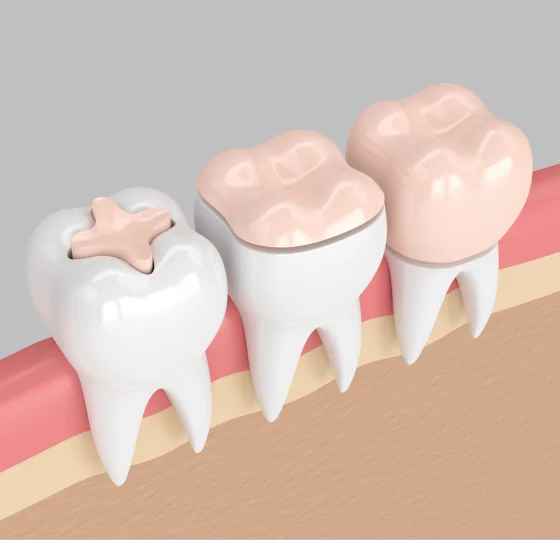
An inlay is used when damage is limited to the top surface of a molar, fitting neatly within the grooves between the cusps without extending over them. An onlay covers more territory, extending over one or more of the cusps when damage is more widespread across the top of the tooth. Both are custom-made to match the shape and color of your natural tooth, then bonded securely into place. Choosing between the two comes down to how much of the tooth needs to be restored, which your doctor determines during your exam.
Why Patients Choose Inlays and Onlays
Inlays and onlays offer a few distinct advantages over jumping straight to a full crown.
- Preserve more of your natural, healthy tooth structure
- Custom-made to fit the exact shape of the damaged area
- Tooth-colored materials blend naturally with the rest of your smile
- Can often prevent the need for a crown or extraction down the road
- Durable enough to handle everyday chewing and biting pressure
How an Inlay or Onlay Is Placed
Placing an inlay or onlay typically takes two visits, giving time for your custom restoration to be crafted precisely to your tooth. Here’s what to expect.
01. Removing Decay or Damage
After numbing the area, the dentist removes any decayed or damaged portions of the tooth, leaving as much healthy structure as possible.
02. Taking an Impression or Scan
A detailed impression or digital scan captures the exact shape of the prepared tooth, which is used to design your custom restoration.
03. Placing a Temporary Restoration
While your permanent inlay or onlay is being made, a temporary filling protects the tooth in the meantime.
04. Fitting the Permanent Restoration
Once ready, the custom-made inlay or onlay is checked for fit and bite before being bonded securely into place.
05. Final Adjustments
The dentist makes any small adjustments needed so the restoration feels comfortable and functions naturally with the rest of your bite.
When Inlays and Onlays Are Recommended
Inlays and onlays tend to come up most often when a cavity has grown too large for a standard filling to repair reliably, but the surrounding tooth structure is still healthy enough that a full crown would remove more of the tooth than necessary. They’re also a common option for replacing an older, failing filling that has started to crack or wear down the tooth around it.
Because the restoration is custom-made outside the mouth before it’s bonded into place, it can achieve a tighter, more precise fit than a filling placed directly during a single visit. At Metropolitan Dental Arts, our experts evaluate the extent of the damage during your exam and let you know whether an inlay, onlay, filling, or crown makes the most sense for your specific tooth.
Caring for Your Inlay or Onlay
An inlay or onlay doesn’t require any special maintenance beyond your normal brushing and flossing routine. Mild sensitivity to temperature is common for a day or two after the numbness wears off and typically resolves on its own. Avoiding especially hard or sticky foods directly on the restoration for the first day or so allows the bonding to fully set. Routine cleanings and exams at Metropolitan Dental Arts give our team the chance to check the fit of your restoration over time and catch any wear before it becomes a bigger issue. With proper care, a well-placed inlay or onlay can last well over a decade.
Save Your Tooth Without a Full Crown
If a cavity or old filling has left more damage than a standard filling can fix, an inlay or onlay might be the right next step. Book online or call our Williamsburg office to schedule a consultation with our team.
Request an AppointmentFrequently Asked Questions About Inlays & Onlays
An inlay fits within the grooves on top of a molar, while an onlay extends over one or more of the tooth’s cusps. Our team at Metropolitan Dental Arts determines which is the right fit based on how much of the tooth needs to be restored.
No. The area is numbed with local anesthesia before your tooth is prepared, so the procedure itself shouldn’t cause pain. Patients at our Williamsburg office typically describe it as similar to getting a filling.
Most patients complete treatment in two visits at Metropolitan Dental Arts, spaced a couple of weeks apart while your custom restoration is made.
With good oral hygiene and regular checkups, an inlay or onlay can last well over a decade. Our Brooklyn team can check the fit and condition of yours at your routine cleanings and exams.
Yes. Inlays and onlays placed at Metropolitan Dental Arts are custom-made from tooth-colored material, so the restoration blends in with the rest of your smile.
In many cases, yes. If enough healthy tooth structure remains, an inlay or onlay can restore the tooth while preserving more of its natural structure than a full crown would require. Our doctors can evaluate which option fits your specific tooth.
Many dental insurance plans offer partial coverage for inlays and onlays, though the amount varies by provider. Our team at Metropolitan Dental Arts can help verify your specific benefits.
If a cavity or old filling has damaged more of your tooth than a standard filling can reliably repair, an inlay or onlay may be recommended. A routine exam at our Williamsburg office is often how this is caught before the damage progresses further.