A Permanent Solution for a Missing Tooth
A missing tooth affects more than your smile, making it harder to chew certain foods, changing the way you speak, and often chipping away at your confidence along the way. At Metropolitan Dental Arts, dental implants offer a permanent way to replace that missing tooth, functioning and looking like a natural part of your smile rather than something removable.
Patients throughout Williamsburg, Greenpoint, and the wider Brooklyn area choose implants because the treatment is planned and placed by our in-house team, which includes an oral surgeon, periodontist, and general dentists working together on your case. Unlike other tooth replacement options, an implant stands on its own in the jawbone, without relying on neighboring teeth for support.
Schedule an Implant ConsultationWhat a Dental Implant Is Made Of
A dental implant is built from three separate parts that work together to replace a missing tooth. The implant post, a small titanium fixture, is placed into the jawbone and acts as the foundation for everything else. An abutment connects that post to the final piece, a custom-made crown designed to match the shape and color of your surrounding teeth. Once fully healed and in place, the result functions and looks like a natural tooth, restoring both your bite and your smile.
Why Patients Choose Dental Implants
Beyond replacing what’s missing, implants offer a few benefits that other tooth replacement options can’t match.
- Prevents neighboring teeth from shifting into the open space
- Helps preserve jawbone density, since the post stimulates the bone much like a natural tooth root
- Stands independently in the jawbone, without relying on the strength of nearby teeth
- Built to last for decades, and often a lifetime, with proper care
- Functions and feels like a natural tooth during everyday eating and speaking
Types of Dental Implants
Not every patient missing teeth needs the same solution, which is why implant treatment isn’t one-size-fits-all. Depending on how many teeth you’re replacing and the condition of your jawbone, one of the following options is likely to fit your situation.
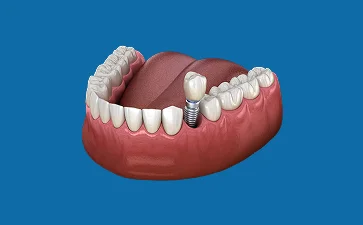
Single Tooth Implants
Not every patient missing teeth needs the same solution, which is why implant treatment isn’t one-size-fits-all. Depending on how many teeth you’re replacing and the condition of your jawbone, one of the following options is likely to fit your situation.
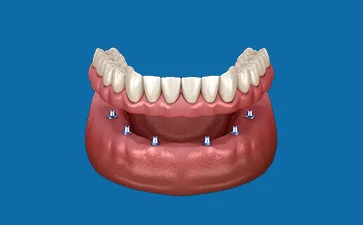
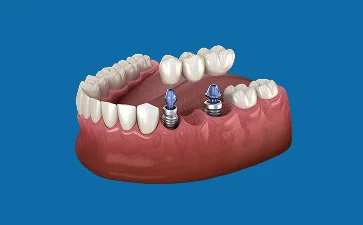
Implant-Supported Bridges
For patients missing several teeth in a row, two or more implants anchor a bridge across the gap, eliminating the need to reshape healthy teeth just to support it.
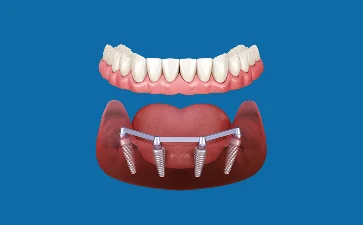
All-on-4
Patients missing most or all of the teeth in one arch can replace the entire arch with a fixed, non-removable restoration supported by just four strategically placed implants.
Implant-Supported Dentures
A removable denture is secured to a small number of implants, offering more stability and chewing power than a traditional denture that rests on the gums alone.
We will recommend the right option for you based on how many teeth need replacing, your jawbone density, and your overall treatment goals.
The Dental Implant Process, from Start to Finish
Getting a dental implant takes place in stages, with healing time built in between each one. Here’s what the full process typically looks like.
01. Consultation and Planning
The dentist evaluates your jawbone density and oral health, using digital imaging and an in-office 3D-printed surgical guide to plan the exact placement of your implant.
02. Placing the Implant Post
The titanium post is surgically placed into your jawbone under local anesthesia, with sedation options available for patients who feel anxious about the procedure.
03. Healing and Osseointegration
Over the following three to six months, the post fuses with your jawbone through a process called osseointegration, creating a stable foundation for the rest of the implant.
04. Placing the Abutment
Once healing is complete, an abutment is attached to the post, connecting it to the crown that will complete your restoration.
05. Fitting Your Permanent Crown
A custom-made crown, matched to the shade and shape of your surrounding teeth, is placed and checked for proper bite and function, with adjustments made as needed.
What to Expect During Recovery
Most of the discomfort associated with dental implants happens in the days immediately following surgery rather than during the procedure itself, since the area is fully numbed beforehand. Soreness, mild swelling, and some bruising are common for the first several days and can typically be managed with over-the-counter pain medication. Soft tissue around the implant site usually heals within one to two weeks, though the deeper process of osseointegration takes several months to complete.
Following your dentist’s post-operative instructions, along with keeping up with follow-up appointments, plays a big role in how smoothly recovery goes. Factors like bone density, general health, and smoking can all affect healing time, which is something our team discusses with you during planning.
A High Success Rate, Backed by Careful Planning
Dental implants have a success rate between 90 and 98 percent, among the highest of any tooth replacement option available today. That success depends heavily on factors like bone density, oral hygiene, and overall health, which is why planning matters just as much as the surgery itself.
Our team uses digital imaging and custom surgical guides to position each implant precisely relative to your bone structure before treatment ever begins. Keeping up with oral hygiene and routine checkups after placement also plays a significant role in how well an implant holds up over time. Complications are uncommon when implants are properly planned, placed, and maintained.
Restore Your Smile with a Permanent Solution
If a missing tooth has been affecting your confidence or your bite, a dental implant could be the lasting fix you’re looking for. Book online or call our office in Brooklyn, NY, to schedule a consultation with our team.
Request an AppointmentFrequently Asked Questions About Dental Implants
Most patients report less discomfort than they expect, often comparing it to a tooth extraction. The area is fully numbed with local anesthesia, and our Williamsburg team offers sedation options for patients who feel anxious about the procedure.
Cost depends on the number of teeth being replaced and whether preparatory treatment like a bone graft is needed. We provide a transparent cost breakdown during your consultation, along with flexible financing options.
Most adults with healthy gums and sufficient jawbone density are strong candidates. If bone loss is a concern, our team can often perform a bone graft to make implants possible, and we evaluate factors like smoking or diabetes as part of your consultation.
The full process typically takes three to six months, most of which is healing time for osseointegration, when the implant fuses with your jawbone. Once that’s complete, our Brooklyn team places your custom, permanent crown.
With proper oral hygiene and regular checkups, the titanium post itself can last a lifetime. The crown on top may need replacement after fifteen years or more of normal wear, which our team can handle during a routine visit.
Not always. A bone graft is only needed if there isn’t enough jawbone density to support an implant, which our doctors can determine using digital imaging during your consultation at Metropolitan Dental Arts.
Yes. Implants can replace a single tooth, support a bridge across several missing teeth, or anchor a full-arch restoration like All-on-4 for patients missing most or all of their teeth in one arch.
Implant treatment is planned and placed by our in-house team, which includes specialists such as an oral surgeon and periodontist working alongside our general dentists, so your care stays coordinated under one roof in Williamsburg.